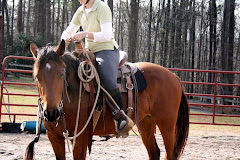
India prefers her left lead to her right, so Jenny's been working with POTU on that. This vid shows India on the right lead twice and then once on her left.
For you non-horsey types, and I know there are a few of you out there, you may be asking yourselves, "What the heck is a lead?" Well, rather than my write it out, I visit Wikipedia and as I expected, there's a great explanation there.
Let's start with the canter, because that is the gait where leads happen. Here's what Wiki has to say: The canter is a three-beat gait, meaning that there are three footfalls heard per stride. Each footfall is the "grounding" phase of a leg. The three footfalls are evenly spaced, and followed by the "suspension" phase of the gait, which is when all four legs are off the ground. The three beats and suspension are considered one stride. The movement for one stride is as follows:
- Beat One: the grounding phase of the outside hind leg. There are many riders who think a front leg is the first beat of the canter, which is incorrect. At this time, the other three legs are off the ground.
- Beat Two: the simultaneous grounding phase of the inside hind leg and outside fore leg. The inside fore leg is still off the ground. The outside hind leg (beat one), is still touching the ground, but is about to be lifted off.
- Beat Three: The grounding phase of the inside foreleg. The outside hind leg (beat one), is off the ground. The inside hind leg and outside foreleg are still touching the ground, but are about to be lifted up.
- The inside hindleg and outside foreleg (beat two) are lifted off the ground. The inside foreleg is the only foot supporting the horse's weight.
- The inside foreleg is lifted off the ground.
- Suspension: The horse has all four legs off the ground.
The faster the horse is moving, the longer is the time of the phase of suspension relative to the time of the three beats. And then they have a video of a woman cantering along on a gorgeous, white Andalusian on a never ending field of green, green grass. It looks like a commercial for shampoo or fertilizer. It's mesmerizing. Oh, this horse is on its right lead. Go. Look. I'll be here when you hit the back button. She never, ever stops. That horse will be cantering until the end of time or the intarwebz, whichever comes first. I'm voting it's time.
Ok, wasn't that cool? But there's more:
The "lead" of a canter refers to the order in which the legs are placed, and is determined by which leg is the last to ground before the suspension phase. If the left hind leg is placed first (beat one), which would then be followed by the right hind and left foreleg (beat two), before the right foreleg (beat three), the horse is said to be on the "right lead." If the right hind leg is beat one, then the left foreleg will be the last leg to ground, and the horse will be said to be on the "left lead." Therefore, a person on the ground can tell which lead the horse is on by watching the front and rear legs and determining which is the last one to touch the ground, but may also simply watch to see on which side the legs are literally "leading", landing in front of the opposing side.
When the horse is on a lead, the legs on that side (usually the inside front and hind) have greater extension than those on the other side (usually the outside front and hind). Therefore, a horse on the right lead will have its right hind (beat two) come slightly further under its body than the left hindleg had when it grounded (beat one), and the right foreleg (beat three) will reach further out from the horse's body than the left foreleg had extended (beat two).
In general, the horse is on the "correct" lead when it matches the direction it is going. So a horse turning to the right should be on the right lead, a horse turning to the left should be on the left lead. However, just as people find it easier to write with one hand or the other, most horses have a "better side", on which they find it easier to lead at a canter. In limited circumstances, mostly in dressage training, a horse may be deliberately asked to take the lead opposite of the direction it is traveling. In such cases, this type of canter is called a counter-canter.
A variant canter, involving the same sequence of beats but variant footfalls in beats one and two, is often referred to by equestrians as cross-firing, cross-cantering, or disunited canter, among other terms. To the observer, the horse appears to be leading with one leg in front, but the opposite leg behind. It is produced by an improper sequence of footfalls.
The problem with this sequence is in beat two: the grounded hind and foreleg are NOT diagonal pairs, but are on the same side of the horse (in this case, the outside). This means that the horse is balancing on only one side of its body, which is very difficult for the horse, making it hard to keep the animal balanced, rhythmical, and keeping impulsion. A horse that is cross-firing cannot perform to the best of its ability, and can even be dangerous (such as an unbalanced, cross-firing horse who must jump a huge, solid cross-country obstacle). Additionally, it makes for a very uncomfortable, awkward ride, producing a rolling movement often described as riding an eggbeater, which makes it difficult for the rider to perform to the best of his or her abilities.




No comments:
Post a Comment